Showing posts with label invention. Show all posts

Monday, December 8, 2014

Setting: what you think you know

I took a hiatus from my blog this fall--hello again! For my return post, I've got an unusual way of addressing "place" and "setting" in a novel I was blown away by this year--A Man Came Out of a Door in the Mountain by Adrianne Harun.

The novel could be labeled as an example of magical realism, but that would be simplifying it. More so, it takes a concept--Devil's Hopscotch, a sinister version of the familiar childhood game, in which innocents fall prey to Old Scratch himself--to analyze the much more difficult concept of life in a hardscrabble mountain town, where poverty, racism, and despair aren't quite enough to explain the mysterious disappearances of local Native American girls and the tragedies of five local youths: Leo, Bryan, Ursie, Jackie, and Tessa. Leo narrates their tale as the inevitable outcome of the Devil's insidious interventions, but the story is interspersed with small chapters that use local folklore and the wisdoms of Leo's deceased Uncle Lud to weave the book's meta-perspective and challenge the reader's perceptions of the characters and the labels we might apply to them based on their origins.

Random drawing found on Drawception. Love it!
My favorite such chapter is entitled, His Playground. One of the unusual ways in which the novel addresses setting is that Leo never discloses the exact location or name of his Canadian mountain town, and in this chapter, he disabuses the reader of any notion that he or she can fully answer the question, "Where are we?" while also insisting that we're not completely without knowledge of the place. Here's a snippet:
You know where we are. You do. Even Uncle Lud...declares there's no need to tell you where we are. You've heard of this place. The news was all over it for a while. And they'll be back, Uncle Lud guesses. That's the thing about places like this. People come here to get lost, but all that means is that they want to do whatever they'd like without anyone interfering.... 
If we give the name, if we say, here we are in Canada, in Terrace or Kaslo or Avola, or we tell you that here we are hidden away like a bunch of bush bunnies in Alberta, you'll say, nah, I passed through there on my holidays or my aunt lived near Smithers or my entire band's been here for more generations than your family has years, and that's not the Terrace or Kaslo or the Peace I know. And you'd be right...."
 This accomplishes about a million different things but here are the top 3, I think:
  1. It's a clever way of making the tale feel even more universal and magical.
  2. It points out that the minute we identify a place (especially if we already do happen to know that city, town, or country),we think we know it and will make all kinds of assumptions--even in fiction, and more surprisingly, even if we live there in real life!
  3. It implies that, despite the anonymity Leo offers, we really do know the specific place he speaks of, but we will pretend we don't so we don't have to acknowledge any potential responsibility or complicity.
For Harun's purposes, this is a great way of negotiating specificity and universality and somehow making it all ten times more interesting--it's also a great way of making the setting support a novel with a very complex voice and narrative. Or, as Leo says, "You see, here's a place where a singular story won't suffice, if one ever could."

Quotes from my Kindle version: Adrianne Harun. A Man Came Out of a Door in the Mountain. New York, NY: Penguin Books; 2014.

Monday, June 16, 2014

"Fiction is the craft of telling truth through lies..."

I just finished reading one of those books that you wish would never end--that book was Lauren Groff's The Monsters of Templeton.

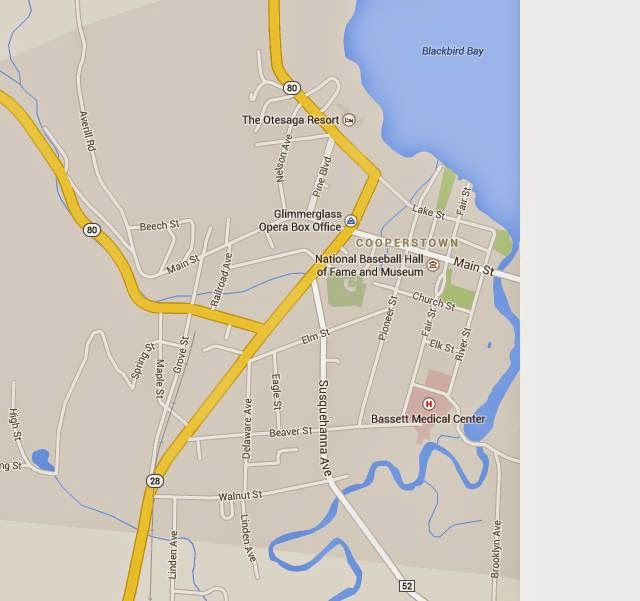
It was inspiring for another reason, too--the novel has a unique method of approach: it takes a real-life town--Cooperstown, New York--and turns it into a magical alter-ego: the fictitious Templeton, New York. Instead of  a pedestrian, run-of-the-mill upstate town that most of us would take for granted, Groff creates a treasure trove of ghosts, lake monsters, and violent family histories for the main character, Wilhelmina (aka Willie), to discover.

Fictional Templeton map, snapped
from Monsters book preview at Amazon
It's a refreshing and interesting approach--a happy medium between creating an entirely new universe (as in some fantasy or sci fi stories) and remaining rigidly faithful to the truth (like a historical biography or a naturalistic period novel). For example, Groff keeps some of the recognizable features of Cooperstown--the family seat of a great American writer, and the home of the Baseball Hall of Fame and Lake Otsego--but she gives them all a twist. She turns James Fenimore Cooper, author of The Last of the Mohicans, into Jacob Franklin Temple, whose family is the town's namesake; she includes the Hall of Fame as is, but incorporates its 1936 inauguration into the plot with a black twist; and Glimmerglass becomes the alternate name of the lake, complete with a Nessie-like monster named Glimmey. She also takes the characters from some of Fennimore Cooper's fiction and turns them into part of Willie's family history: Marmaduke Temple, Natty Bumppo, and Remarkable Pettibones (although Groff calls her Prettybones in this version).

It's also an interesting solution to a common writer's problem--you want to write about a place, time, or subject dear to your heart, but when you begin to faithfully set it down, it suddenly becomes dull and boring. Or, you begin to find other possibilities more interesting.

Real-life Cooperstown map,
snapped from Google Maps
In my Kindle edition, the author's note explains that this is exactly what happened to Groff when she first set out to write the novel. She says she first started reading as much as she could about Fenimore Cooper, because he's so close to the history of the town, and she wanted to stick to that, but:
"...a curious thing happened: the more I knew, the more the facts drifted from their moorings. They began shaping themselves into stories in my head, taking over. Dates switched, babies were born who never actually existed, historical figures grew new personalities and began to do frightening things. I slowly began to notice that I wasn't writing about Cooperstown anymore, but rather a slantwise version of the original."
She then returned to reading Fenimore Cooper and noticed that in his novel, The Pioneers, he reinvented his town as "Templeton, New York," thus granting her a kind of permission to do the same. Groff says: "I relaxed and followed his lead." And in the end, she discovered that "...fiction is the craft of telling truth through lies."

So, reread your favorite author, or take inspiration from a history book, a Golden Classic, or even something as exotic as a grimoire--and don't be afraid to steal, borrow, or completely rearrange material. You never know what could take shape.


Wednesday, June 11, 2014

Names: get a bigger bang for your buck

The movie "Maleficent" is out now, and besides admiring Angelina Jolie's razor-charp cheekbones, it had me thinking about how Maleficent is probably one of the better character names I've come across.

Creating character names seems to be kind of like how pharmaceutical companies come up with prescription drug names--you don't want anything too on the money, but with enough suggestion that people get your "message" without you having to lift a finger. The FDA won't let you get away with calling an Rx "Sleepy-time", but they're okay with "Lunesta," which is sort of a combination of the romance language root for "moon" ("lune" or "luna") and "rest" (without the "r", of course.)

Same with characters--it's never good to name a villain "Mistress Black Hat" but a name like "Maleficent" tells you all you really need to know, even before you start reading. Consider all the nice little suggestions in the name--it's contains a bit of all of these:

Jolie as Maleficent, from Eonline.
1. Mal or Malevolent -- "Mal" being french for "bad", and "malevolent" meaning evil or ill-willed in English.
2. Magnificent -- Awesome, extravagant, larger-than-life
3. Millicent -- A girl's name meaning "work" or "strength"
4. Mellifluous -- Of sound, meaning sweet or musical
5. Cent -- This might be a stretch, but "cent" reminds me of "century", which suggests something ancient

The resulting combination hints at a character who is powerful and strong, ancient and dangerous, and possibly even beautiful or delicate. Not bad for four syllables.